Why Hospital OPDs Become Crowded
Uneven Patient Arrivals Create Peak-Hour Congestion
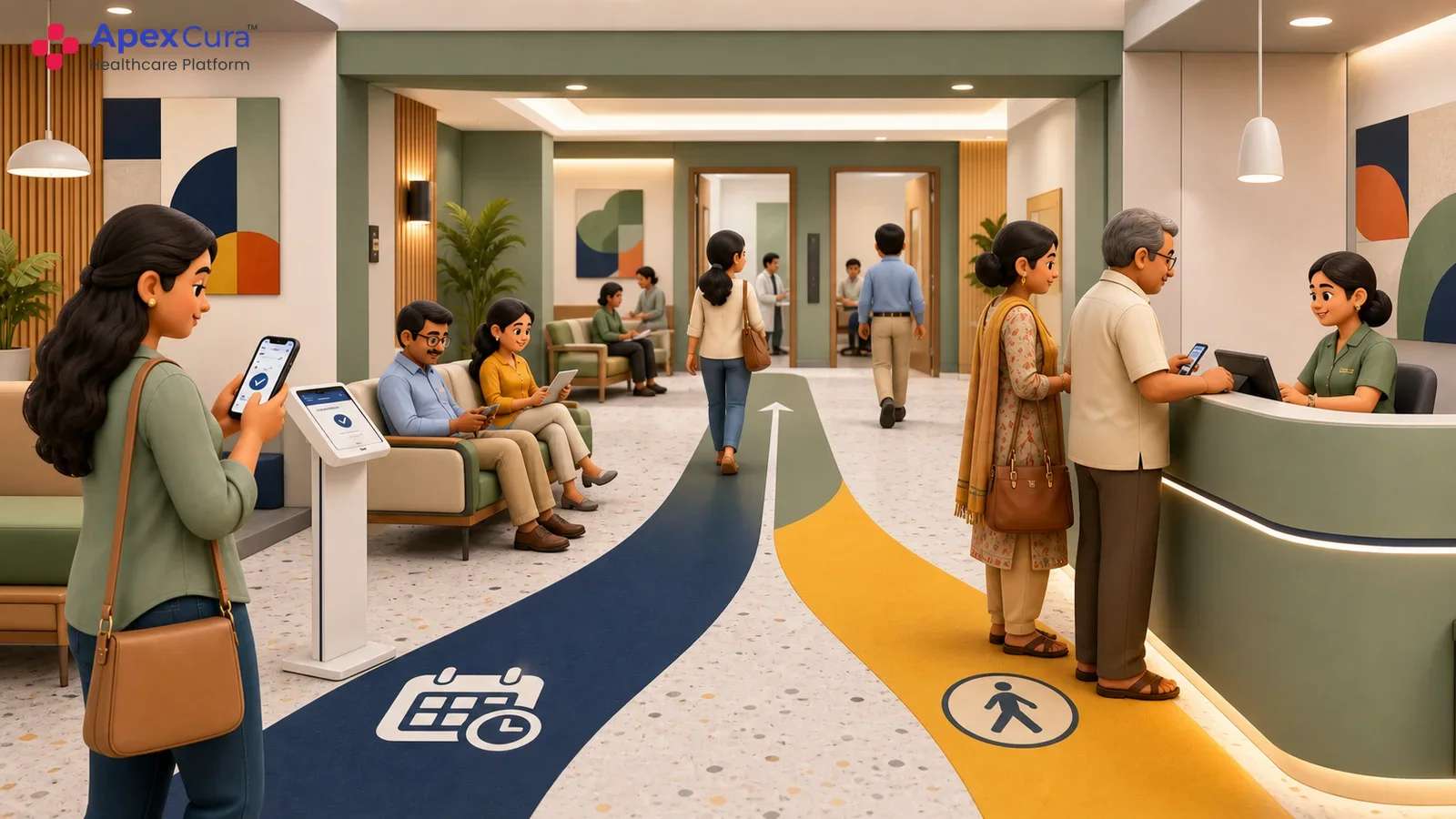
Patient arrivals are rarely distributed evenly across the day. Popular doctors, fixed appointment blocks, transport patterns, walk-in behaviour and preferred consultation timings can cause many patients to arrive within a short period. Registration and billing counters may then receive more patients than they can process, followed by a sudden increase in doctor queues. Even when the total daily patient volume is manageable, short periods of concentrated demand can create significant crowding. This makes peak-hour congestion a capacity-matching problem rather than simply a consequence of high overall OPD volumes. Reviewing arrivals in consistent time bands shows when demand begins exceeding available service capacity.
Delays Across Registration, Billing and Consultation Accumulate
Crowding can also develop when delays accumulate across different stages of the OPD journey. Slow registration may cause many patients to reach billing late, while a billing backlog can delay entry into the doctor queue. Late consultation starts or longer service times may then keep patients waiting even after earlier stages recover. These delays are connected, so congestion visible outside a consultation room may have started much earlier in the patient journey. Looking at only one queue can therefore hide the real source of waiting and make it difficult to understand why patient flow has slowed across the overall OPD.
Lack of Real-Time Visibility Allows Bottlenecks to Grow Unnoticed
Many OPD bottlenecks become visible only after waiting areas are already crowded or patient complaints begin increasing. Separate departmental lists, verbal updates and delayed reporting can make it difficult for operations teams to see that a doctor queue, registration counter or service point has stopped moving. By the time the problem is noticed, patients may already be accumulating across multiple stages. Lack of real-time visibility therefore turns smaller local delays into larger operational issues because hospital teams do not have an early view of where patient flow is slowing down or which team should investigate first during each busy period.
How Hospitals Can Identify and Reduce OPD Waiting Time
Use Appointment Scheduling to Spread Patient Arrivals Across the Day
Appointments can help reduce crowding when they are used to distribute patient arrivals according to available doctor capacity. Simply assigning booking times may not help if too many patients are given similar slots or if actual consultation durations are ignored. Hospitals should consider doctor start times, expected service time, new versus follow-up visits and known peak periods while planning appointments. Comparing scheduled times with actual arrival patterns can reveal slots that repeatedly create congestion. Better scheduling can smooth demand across the day more consistently while still preserving sufficient flexibility for walk-ins, delays and unexpected clinical requirements during each OPD session.
Identify Whether Delays Are Caused by Doctors, Patients or Operations
Hospitals should classify the source of waiting before deciding how to respond. Doctor-induced delays may include late starts, emergencies or longer consultations. Patient-induced delays may include late arrivals, no-shows and missed turns, while operations-induced delays may originate from registration, billing, room allocation or coordination failures. Each category requires a different intervention. Treating every long wait as the same problem can lead to broad actions that add cost without improving flow. Clear delay classification helps management understand the root cause, identify the responsible process and focus improvement efforts where they can have the greatest measurable effect over time in daily practice.
Use Queue Data to Improve Staffing, Scheduling and Patient Flow
Queue data can reveal recurring patterns that are difficult to identify through observation alone. Hospitals can compare patient arrivals, waiting time, service time and queue movement across doctors, departments, days and time periods. These patterns may show overcrowded appointment blocks, inadequate peak-hour staffing, delayed doctor starts or weak handovers between services. Operations teams can then select a specific intervention, assign ownership and measure whether it improves the result. Actions may include changing appointment slots, opening counters earlier, adding floor support or improving coordination between departments. Queue data becomes useful when it leads to measurable and sustained operational changes over time.
Monitor OPD queues, identify growing bottlenecks and use waiting-time data to improve patient flow.
Explore Apex Cura Hospital Queue ManagementExplore Apex Cura Hospital Queue Management
Monitor Queues Across Doctors, Departments and Service Points in Real Time
Apex QMS provides operations teams with a live view of active queues across doctors, departments and service points. Teams can see where patients are accumulating, which queues are moving normally and which areas need attention. This shared operational view reduces dependence on separate departmental lists, phone calls or delayed reports. Authorised users can review current patient counts, queue status and recent movement. They can then focus investigation on the affected stage rather than searching across the entire OPD. Real-time visibility creates an earlier opportunity to respond more quickly when patient flow begins slowing, before congestion spreads across other waiting areas.
Escalate Abnormal Delays and Bottlenecks to Operations Teams
Apex QMS can help identify abnormal waiting conditions and escalate them to operations managers when queue movement or waiting time falls outside defined expectations. Alerts can be shared through operational dashboards or WhatsApp so that managers do not have to continuously watch every doctor or service queue. The system provides visibility into the affected queue, while hospital teams determine the actual cause and appropriate response. This may involve investigating a doctor delay, staffing issue, room constraint or upstream service problem. Early escalation helps operations teams respond and intervene sooner, before a manageable delay develops into visible crowding and widespread patient dissatisfaction.
Track Queue KPIs to Improve OPD Flow
Apex QMS can help hospitals track waiting time, service time, queue movement and recurring delay patterns across doctors, departments and operating periods. Management can establish a baseline, identify persistent bottlenecks and compare performance after changing appointment schedules, staffing or operational workflows. The same definitions and patient groups should be used before and after an intervention so that the result remains comparable. Teams can then decide whether to retain, revise or stop the change. This creates a disciplined improvement loop: identify a problem, assign corrective action, measure the operational result and review whether patient flow improved consistently across subsequent OPD sessions.
Conclusion
Reducing OPD waiting time requires hospitals to manage patient demand, service capacity and operational delays together. Appointment scheduling can help spread arrivals, while clear delay classification reveals whether waiting originates from doctors, patients or internal processes. Real-time queue visibility and early escalation allow teams to intervene before crowding becomes severe. Apex QMS supports this process by providing visibility, queue KPIs and delay alerts. The objective is not only to reduce visible queues, but to improve patient flow through measurable operational decisions. Hospitals can start with one bottleneck, assign an owner and compare the same measure after implementing a focused change.