Configurable Queues
Configure queue rules by department, doctor, patient type, and appointment schedule.
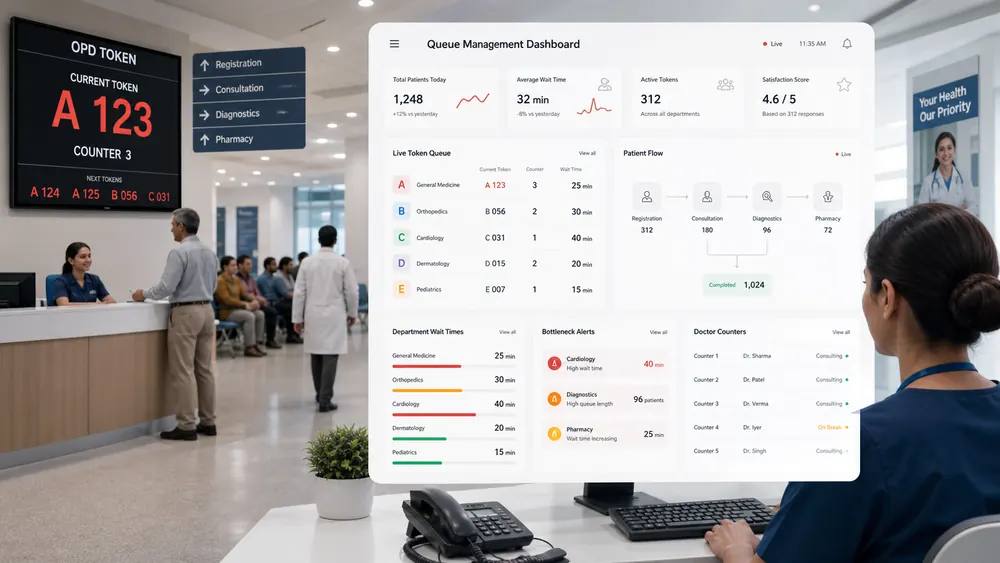
Synchronise appointments, registrations, billing and walk-ins into one OPD queue. Manage arrivals, no-shows, doctor-room schedules, token displays, manual overrides and waiting-time bottlenecks so patients move through the hospital with better clarity and control every day.
Combine appointment schedules, registration, billing, and walk-in arrivals before prioritising patients for the consultation room.
Configure queue rules by department, doctor, patient type, and appointment schedule.
Balance appointment and walk-in patients fairly using configurable priority rules automatically.
Identify waiting-time delays and queue bottlenecks early for timely floor-level intervention.
Monitor queues, delays, room utilisation, and bottlenecks across departments.
Move patients from expected arrival to consultation while preserving operational control for the floor team.
Appointments, registrations, and billing events create the expected queue.
The system identifies arrived patients, walk-ins, delays, and no-shows.
Rules balance appointment time, arrival time, patient type, and operational conditions.
Authorised staff can override priority and communicate delays when floor conditions change.
Waiting time, consultation service time, throughput, and bottlenecks are recorded.
Handle routine patient flow and complex doctor-room scenarios without losing transparency.
Import expected appointments and continuously reconcile arrivals, no-shows, and reschedules.
Merge both patient types into one fair queue without automatically disadvantaging walk-ins.
Measure patient waiting time and doctor or department service time at each stage.
Show token movement and current queue status clearly in the OPD lobby.
Inform patients when a doctor emergency or operational change is likely to affect waiting time.
Allow authorised doctor secretaries to alter system priority with operational traceability.
Support doctor changes, multiple rooms per doctor, and shared rooms according to schedule.
Give OPD managers immediate visibility into queues, bottlenecks, delays, and intervention needs.
A hospital queue system must synchronise operational data, calculate priorities, and support real floor exceptions.
Synchronise the systems and touchpoints required to maintain an accurate real-time OPD queue.
Create transparency for patients while giving floor managers the information required to intervene early.
Reduce patient waiting from arrival to doctor consultation across departments.
Coordinate doctors, secretaries, floor managers, and front-desk teams in real time.
Improve patient satisfaction through shorter waits and clearer queue communication.
Show patients their queue position, progress, and expected consultation status.
Notify patients early about doctor delays, emergencies, and queue changes.
Reduce complaints caused by uncertainty, delays, and unclear queue prioritisation.
Replace manual coordination with structured, trackable digital queue workflows.
Give doctors clarity on waiting patients, queue load, and consultation priorities.
ApexCura synchronises arrivals, appointments, doctor availability, and queue movement to identify delays and improve patient flow.
ApexCura uses configurable priority rules based on appointment time, arrival, patient type, and current operational conditions.
Patients receive queue updates and delay notifications through display screens and configured digital communication channels.
Yes. Authorised staff can override system priorities while maintaining user accountability and complete change traceability.
The system records patient movement across queue stages and calculates waiting and service times by doctor and department.
Yes. It supports doctors changing rooms, using multiple rooms, and sharing rooms according to daily schedules.
Real-time dashboards highlight delayed doctors, congested queues, room utilisation, service-time variations, and intervention points.
Yes. ApexCura compares waiting time, throughput, no-shows, service time, and queue performance across locations.
Practical guides on waiting time, digital tokens, implementation, and hospital patient flow.
Understand how queue management improves OPD visibility, patient flow, and waiting-time control.
Read Why a Queue Management System for Hospitals Matters in Modern OPD OperationsSee how completed visits and stage-wise conversion tracking connect patient acquisition with OPD outcomes.
Read How Hospitals Can Improve Enquiry Conversion RatesLearn how hospital groups can route enquiries by geography, specialty, language, and branch context.
Read How Multi-Branch Hospital Groups Can Centralise Patient Acquisition
At Apex Cura, we specialize in providing cutting-edge healthcare technology solutions tailored to meet the unique needs of the Hospitals. With a focus on leveraging AI and advanced analytics, we are dedicated to empowering hospitals to achieve operational excellence and superior patient care and drive better financial and medical outcomes.
© Copyright 2026.
All rights reserved.


