
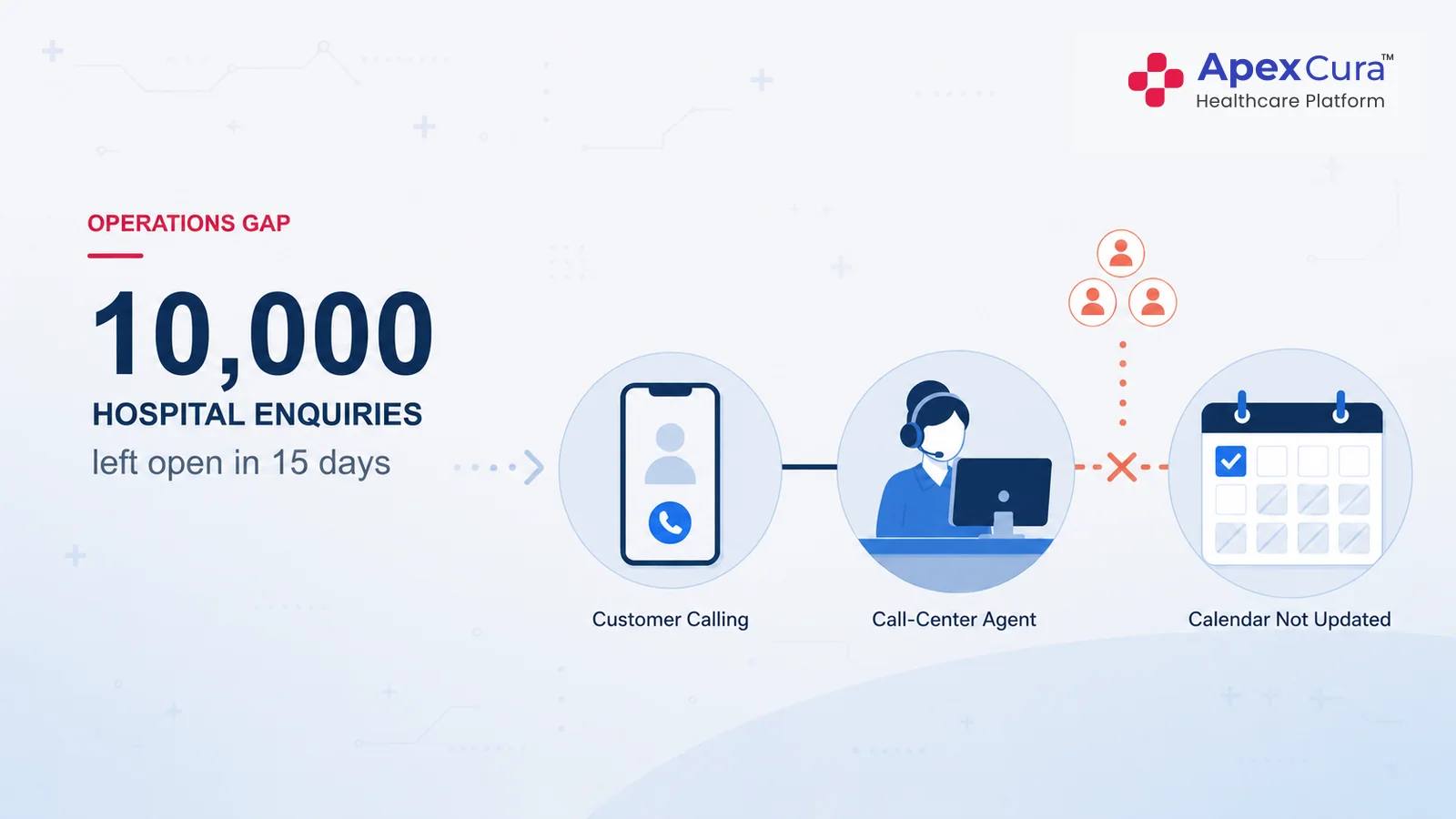
One Weak Link Disrupted the Entire Booking Process
Marketing Team Was Generating Demand
The marketing team was investing significant time and budget in studying competition, identifying high-potential services and locations, selecting appropriate channels and running targeted campaigns. Every enquiry reaching the call centre represented patient interest created through this research and spending. The hospital had already incurred the cost of attracting the patient and persuading them to make contact. The next priority was to convert that acquired demand into a confirmed appointment and hospital visit.
Call Centre Team Was Booking Appointments
The call centre had deployed trained agents and appropriate shift coverage to answer calls and respond to digital enquiries within the prescribed TAT. Agents understood patient requirements, provided relevant information with empathy and attempted to convert enquiries into appointments. Patient intent was present, and the call-centre team was making every effort to convert each enquiry into a confirmed appointment.
Branch Operations Team Did Not Update Doctor Availability
The branch operations team had only one day of doctor availability and usually shared this information with the call centre at 4 PM the day before. Consequently, agents had an extremely narrow booking window and could not confirm appointments requested for later dates. The underlying issue was a process that depended on doctors reconfirming routine availability every day. A forward schedule should have remained valid by default, with branch teams reporting only leave, emergencies and other deviations.
The Process Problem And Its Impact
The Scale Became Visible Only When the Pending Pool Was Measured
Over 15 days, the process accumulated 10,000 patient enquiries that could not be converted into appointments. The number changed the nature of the problem. This was not an occasional exception caused by a doctor changing a schedule. It was a structural bottleneck operating every day. Marketing and call-centre teams were generating and handling demand, but the final step required to secure that demand was unavailable to them.
Every enquiry represented patient intent already created through brand, marketing, referrals or previous experience—but blocked by an internal scheduling dependency.
An Open Enquiry Is Not a Secured Appointment
The enquiries remained in a list, but the opportunities did not remain equally valuable. Patient intent decays quickly when a booking is uncertain. Some patients call another hospital, some abandon the plan and others become difficult to reach during follow-up. The longer the delay, the less likely the original enquiry is to become a completed appointment. An enquiry may remain open in the CRM even after its chance of conversion has significantly declined.
The Wrong Team Would Have Appeared Responsible
If management looked only at appointment conversion, the booking team could appear inefficient. In reality, employees could not complete bookings because another team had not made future capacity visible. Measuring teams in isolation would therefore misdiagnose the problem and encourage more calls, more follow-ups or more pressure on appointment agents. None of those actions would repair the missing dependency between doctor scheduling and patient booking.
Can your hospital see exactly why patient enquiries remain unbooked?
Lets Talk To ExploreThe Lesson: Team Coordination Is Essential for Outcomes
Doctor Availability Needs a Defined Planning Horizon
Hospitals must decide how far in advance appointments should be bookable and make doctor availability visible for that full period. The planning horizon may vary by specialty, but it cannot depend on informal updates arriving one day before consultation. Exceptions such as leave, emergency duty or schedule changes should be managed as exceptions. They should not determine the normal booking process for every future enquiry.
Both Teams Need One SLA and One Shared Outcome
The operations team must own the timely publication of schedules, while the appointment team must own conversion once availability is visible. Both responsibilities should be measured within the same workflow. Management should see when schedules were published, how many enquiries could not be booked because capacity was unavailable and what happened after availability was updated. That creates accountability for the handover instead of evaluating each department using disconnected activity metrics.
Appointment Conversion Is an End-to-End Operating Metric
Enquiry conversion depends on marketing, contact-centre response, doctor scheduling, slot visibility and branch execution. Optimising one team while ignoring the others simply moves the bottleneck. Hospitals need a single operational view that connects the patient’s requested date, available capacity, booking attempt, follow-up and final outcome. The 10,000-enquiry backlog was not caused by a lack of patient interest. It was created by one unresolved dependency between two teams.
Conclusion
Hospitals risk losing revenue when internal coordination fails at the exact moment a patient is ready to book. Future doctor availability must be treated as essential appointment inventory, published in advance and governed through shared accountability. Otherwise, thousands of genuine patient opportunities may remain unconverted despite the efforts of a high-performing acquisition team.


