Why Enquiries Stay Buried in a Normal Chatbot
A Normal Chatbot Acts Only on Explicit Requests
A normal chatbot is built around menus, buttons and fixed answers. It creates an enquiry only when the patient chooses an option such as “Book appointment” or “Request callback”. Every other message is treated as a question to answer, not as interest to follow up.
This works for patients who know exactly what they want and press the right button. Many do not. They ask a question, read the answer and move on. The chatbot has done what it was built to do, yet the hospital learns nothing about the patient’s interest. Whether that patient would have welcomed a call from the hospital is never tested.
Routine Questions Often Point to a Hospital Service
Patients rarely write “I would like to book a consultation.” They ask short, practical questions. The question is factual, but the patient’s likely next step is a hospital service.
Doctor availability: “Is the cardiologist available tomorrow?” often comes before an appointment.
Procedure: “Do you do laparoscopic gallbladder surgery?” may come from a patient comparing hospitals.
Diagnostic: “Is a CT scan available on Sunday?” may come before a test booking.
Pricing: “What does a health check-up cost?” often comes before a decision to visit.
None of these messages proves intent on its own. But each one is a signal that a normal chatbot simply answers and forgets.
Buried Chats Never Reach the Team That Converts Them
In a normal chatbot, these conversations sit in the chat history alongside thousands of others. Nobody reads them one by one. Reports count them as questions answered, not as enquiries received.
The hospital’s outbound team, the people best placed to explain options and help a patient decide, never sees them. A patient who asked about the cost of knee replacement and left looks exactly like one who asked for directions. The opportunity is not lost because staff failed to persuade the patient. It is lost because staff never knew the enquiry existed. This is the gap an AI chatbot is designed to close.
How an AI Chatbot Finds the Enquiry in the Chat
Recognising What the Patient Wants From Their Own Words
An AI chatbot uses natural-language processing to identify what the patient is asking for, even when the words do not match the hospital’s menu or terms. This is patient intent recognition. One patient asks for a “heart doctor”, another for a “cardio specialist” and a third for “a doctor for BP and heart”. The AI maps all three to cardiology.
The patient still gets the answer they asked for, such as the fee, the doctor’s timing or the scan availability. The difference is what happens next. The conversation now carries a recognised enquiry, such as an appointment, procedure, diagnostic or pricing enquiry, that the hospital can act on instead of leaving it in the chat history.
Signals an AI Chatbot Can Rely On
Reliable signals are things the patient states in the chat. They include a named treatment, procedure, test or speciality; a named doctor; a day, date or time; a question about price; a branch or location; and words such as book, schedule or available.
Separate three things in every message. The literal message is what the patient wrote. The service intent is the hospital service it points to. An assumption is anything added without evidence. “How much does a knee replacement cost?” is a price question that points to a knee replacement enquiry. Only those two should shape what the AI does next. The patient’s own words remain the evidence for every enquiry it recognises.
What an AI Chatbot Should Not Assume
Some conclusions should never be drawn from chat text. The AI should not guess a patient’s emotional state, ability to pay or clinical condition. A question about parking, visiting hours or the canteen does not indicate an admission. A described symptom is not a diagnosis and is not a reason to suggest a procedure.
Sensitive messages need extra care. When a patient describes a medical concern, the right response is a clear route to a doctor or staff member, not an automated judgement. Limiting intent recognition to stated service interest protects patients and ensures that the calls your outbound team makes are welcome rather than intrusive.
See how the GenAI Chatbot finds enquiries buried in routine patient chats and passes them to your outbound team.
Explore Apex GenAI ChatbotHow AI Passes Buried Enquiries to the Outbound Team
Passing the Chat Even When the Patient Leaves Midway
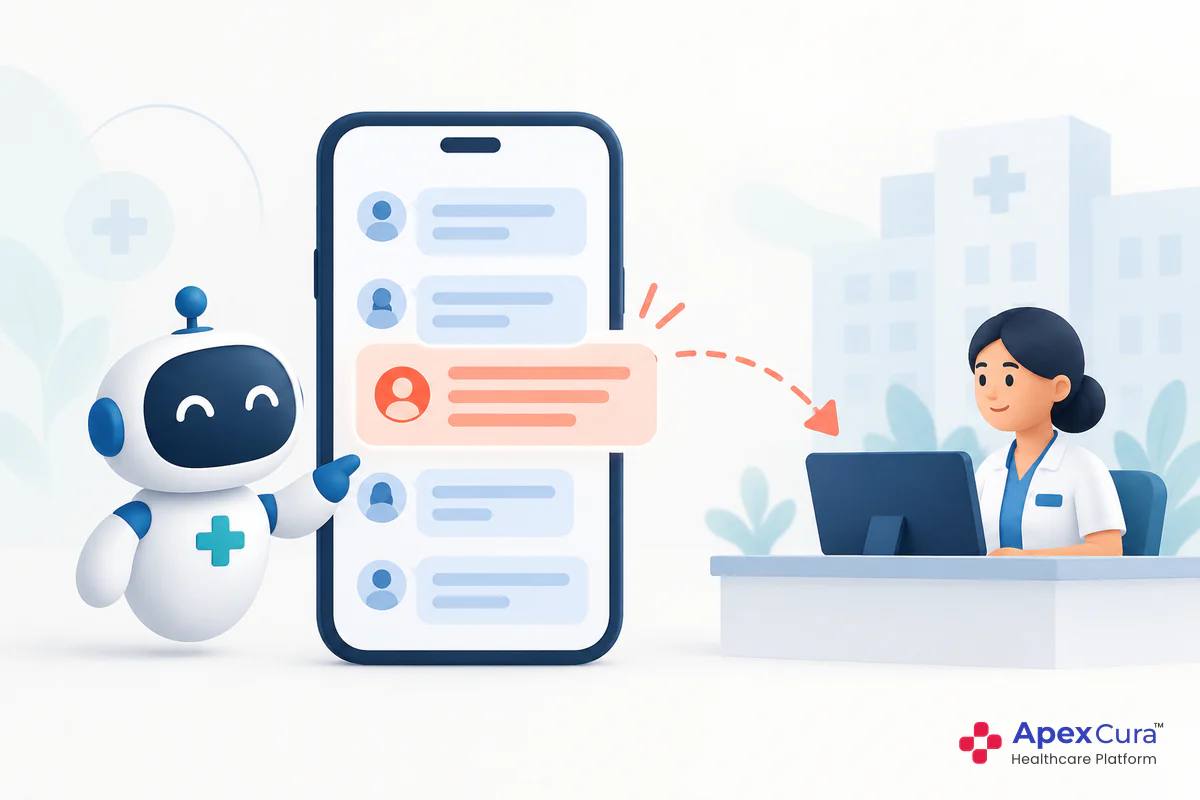
When the AI recognises a service enquiry, it does not wait for the patient to press a button. It escalates the conversation automatically to the hospital’s outbound team with the patient’s details, the identified intent, the source channel and the chat history.
This works even when the conversation is unfinished. A patient who asked about the cost of cataract surgery and then closed the chat still reaches the team. This is the key advantage over a normal chatbot: the enquiry moves to people who can act on it instead of staying buried in the chat history. Chat With a Live Agent explains how the handover itself works.
Asking Early While the Patient Is Still in the Chat
Recovery is easier when the hospital has a way to reach the patient. When a message shows clear interest, the chatbot can ask one short clarifying question and, where needed, the patient’s contact details. For example: “Would you like our orthopaedic team to call you about knee replacement?”
The question should feel helpful, not pushy. If the patient says no, the conversation continues normally and is not passed on as an enquiry. If the patient agrees, the call-back has a clear purpose. Where the hospital has integrated its appointment system, the patient can also book an appointment within the chat straight away, without waiting for a call.
Calling Back With Context
The outbound team’s call is where the enquiry is recovered. Because the chat arrives with its history, the caller already knows what the patient asked, which doctor or branch they mentioned and where the conversation stopped. They can open with the patient’s own question rather than a generic script.
This makes the call useful to the patient: an answer to the cost question, an explanation of the next steps or an appointment offer. It also respects the patient’s time. Hospitals should set a clear call-back time for these enquiries, because a patient’s interest may fade after they leave the conversation, and another hospital may reply first.
How Hospitals Measure Recovered Enquiries
What to Track
Measurement should show how many enquiries the AI now brings out of the chat history and how many the team recovers. Useful measures include:
- Enquiries recognised without the patient making an explicit request, by type.
- Chats passed to the outbound team, including those the patient left midway.
- Call-backs made, and the time taken to make them.
- Recovered enquiries, such as an appointment booked after the call.
- Chats found in later review that contained an enquiry the AI did not pass on.
Together, these show the enquiries that a normal chatbot would have left buried, and how many of them your team recovers.
Not Every Chat Is an Enquiry
The goal is not to turn every message into a sales call. A patient asking for directions or a report status should get a helpful answer and nothing more. Passing too many chats creates its own problems: the outbound team spends time on calls patients did not want, and patients feel pressured.
Review a sample of passed chats regularly. Check those that were not real enquiries, and routine chats that contained an enquiry the AI missed. Use these findings to refine what counts as an enquiry and when the chatbot asks a clarifying question. A smaller number of genuine enquiries is more useful to the outbound team than a long list of uncertain ones.
Conclusion
In a normal chatbot, enquiries that patients never explicitly request stay buried in routine chats. Nobody calls, because nobody knows. An AI chatbot changes this. Patient intent recognition finds the service interest in the patient’s own words, and the chat is passed to the outbound team with full context, even when the patient leaves midway. Your team then does what it does best: call back, answer and help the patient decide. Missing lead identification in hospital chat turns buried conversations into enquiries your team can recover.