Why Centralised Acquisition Fails Across Hospital Groups
Routing becomes complex across regions and specialties
A central team may receive enquiries for several states, languages, branches and treatment areas. Simple round-robin assignment sends patients to the wrong employee when it ignores geography, speciality, service availability, doctor schedules and patient preference. The result is repeated internal call transfers, unclear ownership and poor patient experience. Centralisation fails when it removes local knowledge without replacing it with accurate routing rules and a mechanism for handling exceptions.
Campaign and branch performance lose context
Hospital groups often run multiple regional campaigns from the same Google, Facebook or Instagram account. If campaign metadata is not preserved, the central team cannot compare which region, branch, service or activity generated the enquiry. Lead conversion tracking across branches can also be misleading because branches receive different service mixes and lead quality. A Multi-Branch Hospital CRM can provide group visibility through common definitions and source attribution while retaining the context needed for fair branch-level comparison.
Duplicate identities fragment the patient journey
One patient may use several phone numbers, while one family phone number may be linked to multiple patient registrations. Names may be spelled differently or sound alike across systems. Without identity resolution, the same person appears as several leads and the group loses history when the patient moves between branches. Incorrect merging creates the opposite risk by combining different people. A central operating model must unify patient identity carefully while preserving enquiry episodes, branch ownership and patient choice.
Key insight: The strongest model centralises data, governance and visibility — but facilitates decentralized and flexible branch-level operations.
What are the solutions available for Group Hospitals
Centralise control while preserving local execution
Group leadership should centralise patient identity, campaign metadata, routing rules, SOP definitions, dashboards and escalation. Branches should retain responsibility for local service confirmation, doctor availability, branch-specific communication and final execution. Teams may sit at a corporate central location, but have branch-level visibility and information. Every enquiry should remain visible at group level, while the assigned team owns the next action and is measured against a clearly defined response SLA.
Use a routing hierarchy with exception handling
Routing should consider geography, preferred branch, treatment requirement, speciality & language. The workflow must also handle exceptions: the preferred branch lacks the service, a doctor is unavailable, the patient wants another location or the assigned branch fails to respond. Reassignment and escalation rules should be auditable so management can see why a lead moved and whether the patient’s preference was respected. Automated routing should support judgement, not operate as an unexplained black box.
Compare outcomes using common definitions
Group and branch dashboards should use consistent stages and KPIs, including response TAT, enquiry-to-appointment, appointment-to-footfall, source performance and overdue ownership. Comparisons should account for measuring the efforts, outcomes, process compliance & revenue generation. A common patient profile should connect cross-branch interactions and outcomes, while duplicate-resolution rules manage multiple numbers, shared contacts and spelling variations without erasing history.
How Apex Cura Supports Multi-Branch Patient Acquisition
Unified patient identity and enquiry visibility
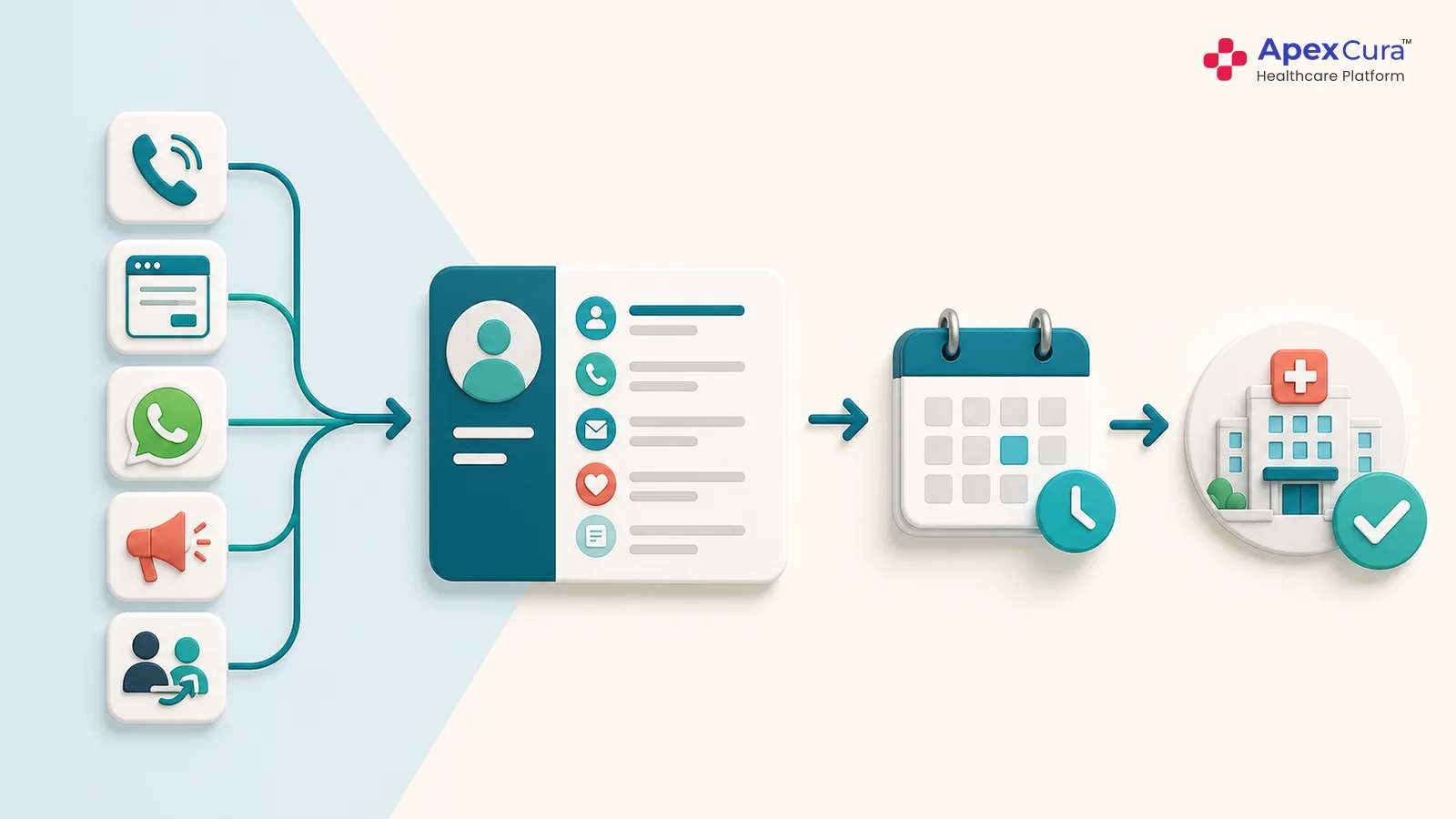
Apex Cura provides a common patient profile across branches and regions so the group can see the patient’s interactions, enquiries and outcomes in one place. Identity-resolution logic helps manage multiple phone numbers, shared family contacts and phonetic or spelling variations while preserving separate enquiry episodes. When a patient moves from one branch or region to another, the receiving team can access the relevant context instead of restarting the journey or creating another disconnected record.
Automated regional and specialty routing
The platform uses defined rules and patient information to route calls and enquiries to the appropriate regional team, branch or treatment specialist. Routing can consider geography, speciality, service availability, language and patient preference, with reassignment and escalation when the selected branch does not act or cannot serve the need. This reduces wrong assignments and unwanted transfers while giving local teams clear ownership of execution.
Group-level campaign and performance control
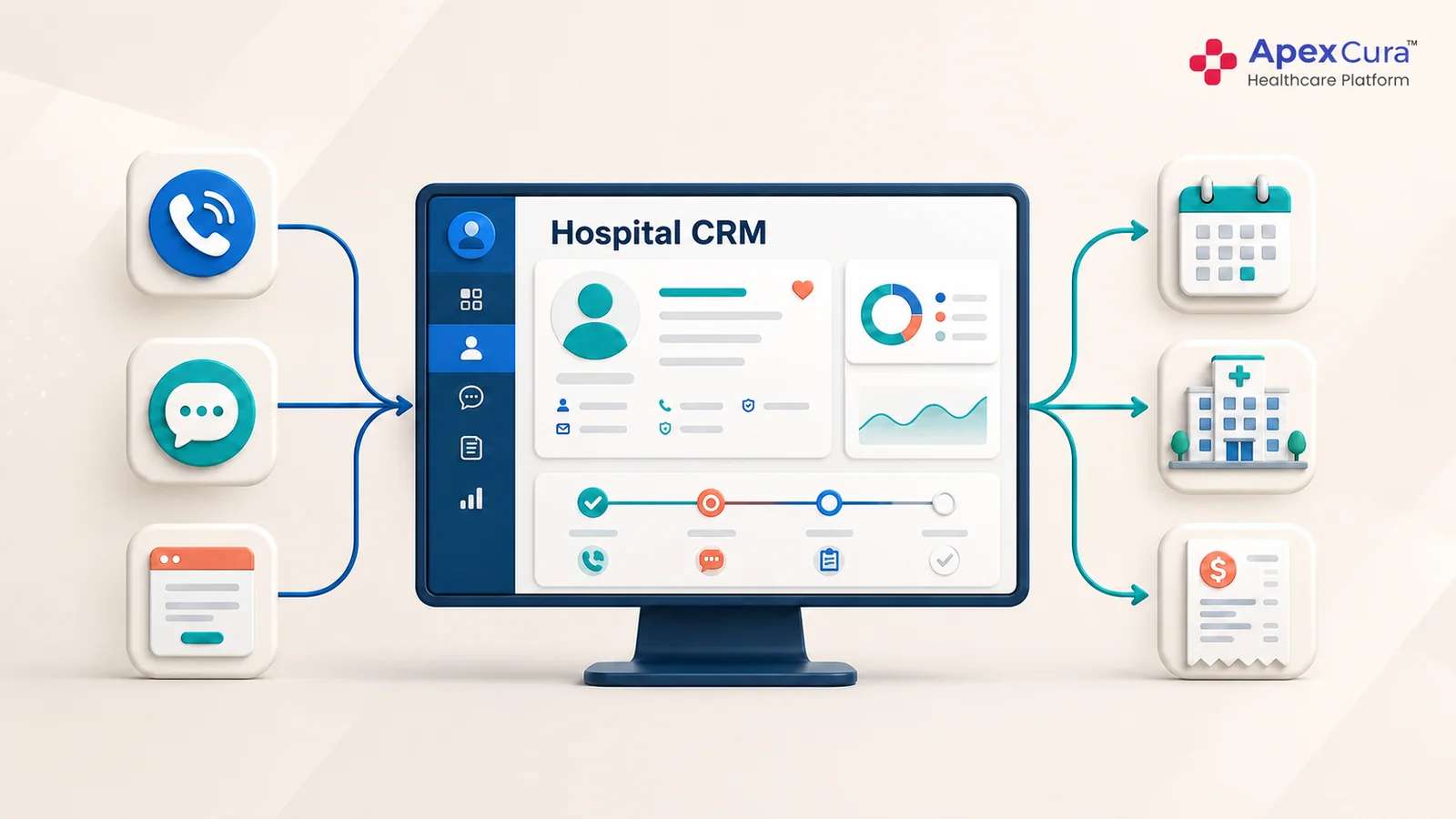
Apex Cura preserves source and campaign metadata across regional activities and provides central and branch-level dashboards. Group leaders can compare response SLA, follow-up, conversion and outcomes across locations using common definitions. Where appointment, OPD and billing integrations are available, the system connects campaign and enquiry data to completed outcomes across branches. This gives the central team control and visibility without requiring every interaction to be handled directly from branch teams. Hospitals evaluating this operating model can explore Hospital CRM Software for multi-branch enquiry management, local ownership and central reporting.
Apex CRM gives hospital groups a connected view of enquiries, branch ownership and measurable outcomes.
See how Apex Healthcare CRM supports multi-branch hospital groups →
Shared Contact Centres Serving Multiple Branches
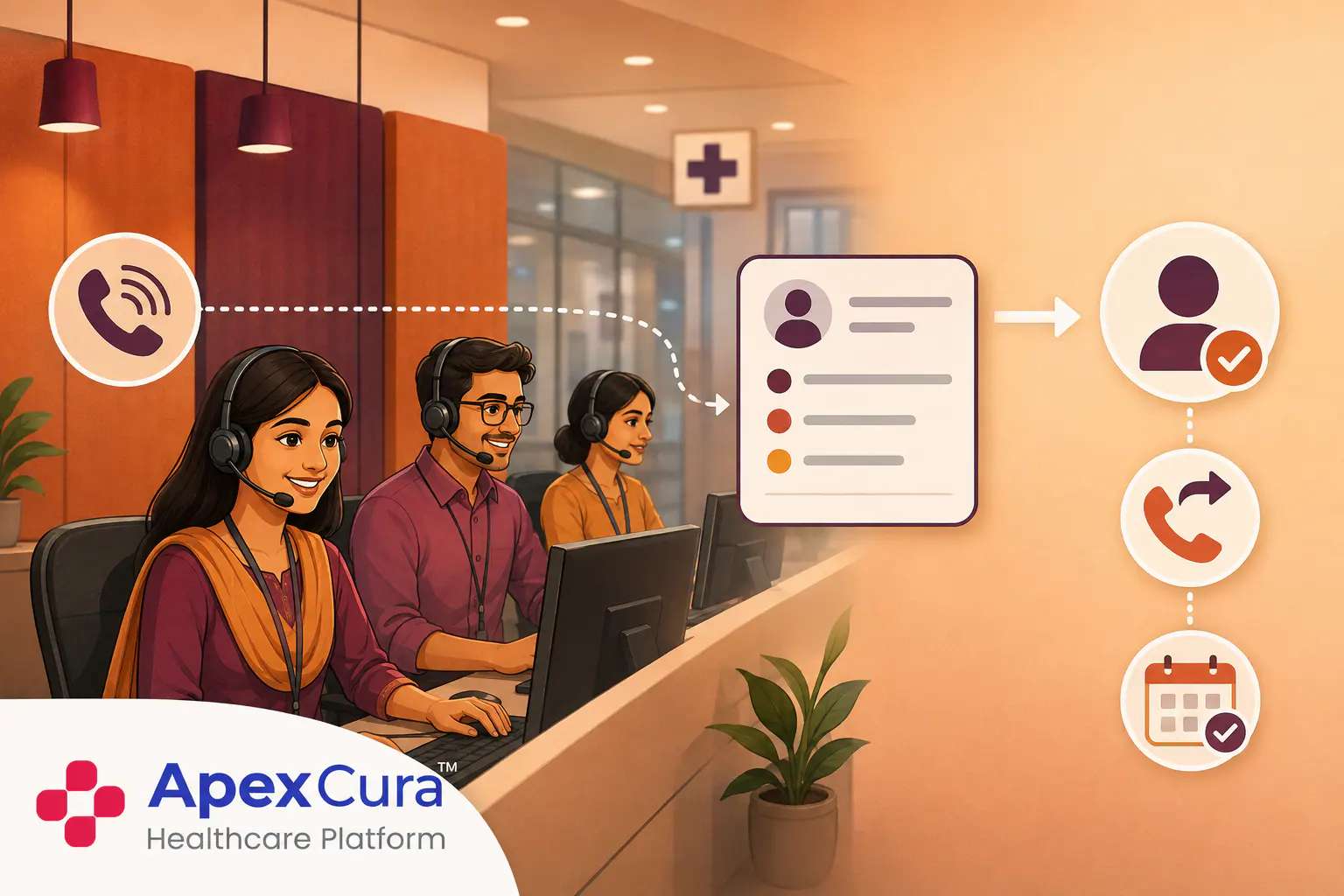
A shared contact centre can receive calls and digital enquiries for several branches. Agents first identify the branch, speciality or location the patient is asking about. They need current information about branch services, doctor availability, languages and operating hours. A common hospital lead management workflow then routes the enquiry with its complete context to the right branch team. Central agents can maintain common response standards, while local teams own appointments, confirmations and actions requiring branch knowledge. Ownership should remain visible until the patient receives a clear outcome, even when the enquiry moves between teams.
Patient Location Preference and How It Overrides Routing Rules
The nearest branch is not always the patient’s preferred branch. A patient may choose another location because of a known doctor, previous treatment, family convenience, transport or insurance support. Location-based routing can provide a useful default when the patient has no preference. Once the patient selects a branch, that choice should take priority over the default rule. Agents should confirm the preference and record it in the enquiry. Management can use hospital CRM analytics to compare the preferred branch, final appointment location and completed visit across the group.
Handling Exceptions When the Preferred Branch Cannot Serve
A preferred branch may not have the required doctor, service, equipment or appointment availability. The original branch or central agent should explain the limitation before offering a suitable alternative. The enquiry must record the patient’s first preference, the reason for rerouting, the new owner and whether the patient accepted the change. If the alternative is declined, the enquiry should remain open for appropriate patient follow-up. Escalation rules should also identify branches that fail to respond. This creates a traceable exception process and helps management distinguish capacity gaps from ordinary lead-routing activity.
Conclusion
Multi-branch patient acquisition works when the hospital group centralises identity, rules, governance and reporting while preserving branch knowledge and accountability. Automated routing, exception handling and a common patient profile allow patients to move across locations without losing context. Centralisation should improve coordination—not create another layer of handoffs.