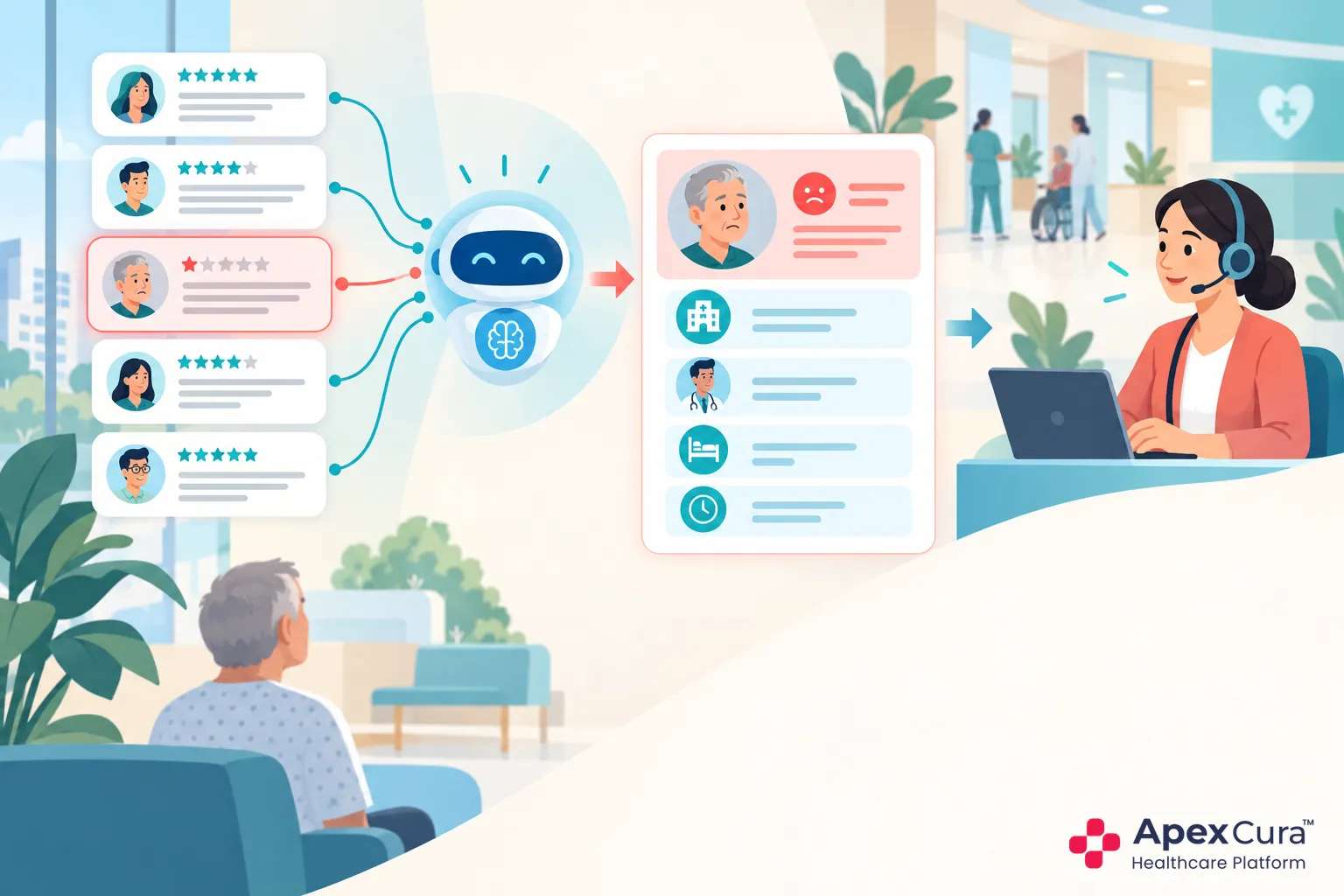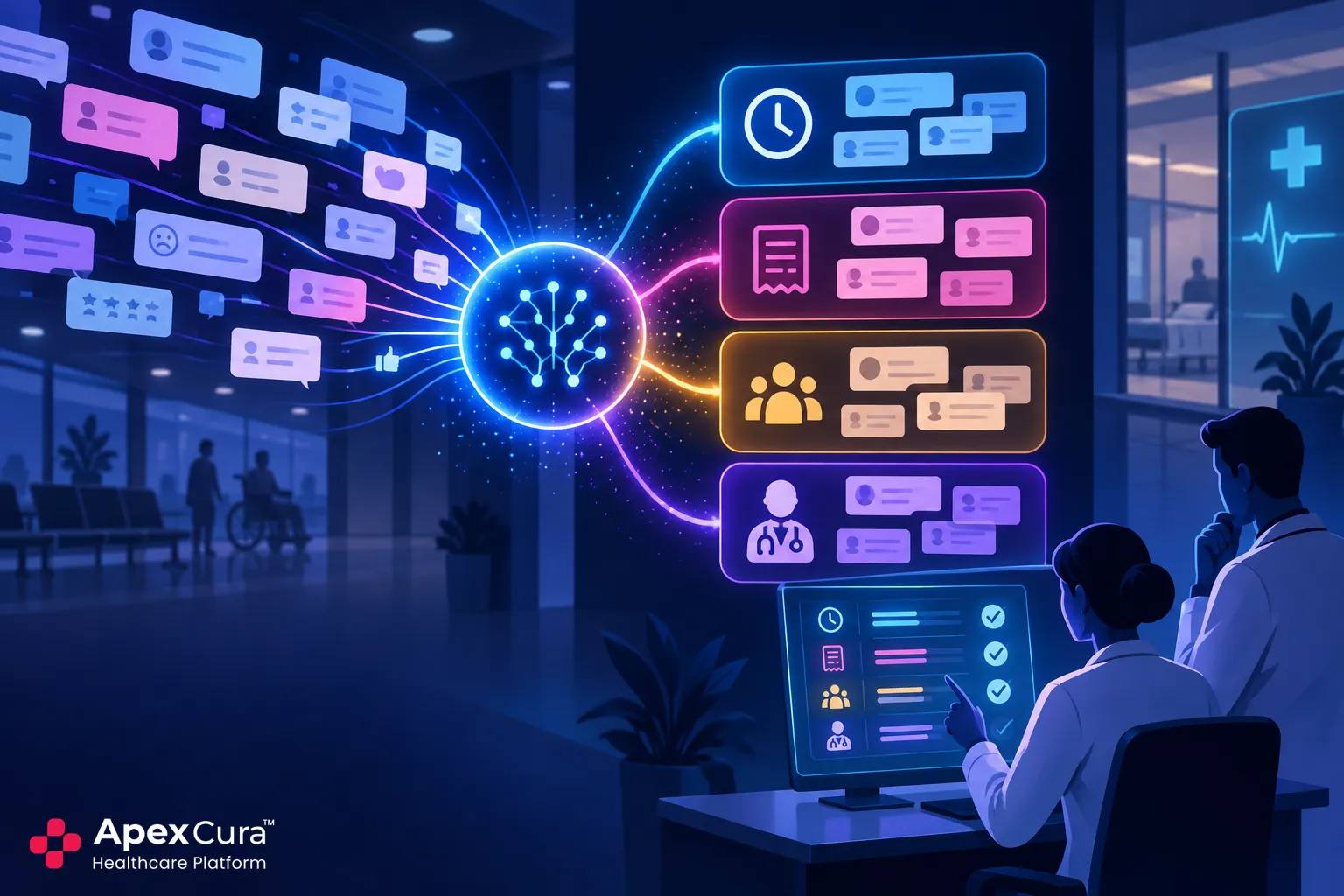
AI Will Group Patient Comments Into Common Themes Across Doctors, Departments and Services
AI Groups Waiting-Time and Convenience Comments Into Operational Experience Themes
Patients describe delays in many ways: “waited too long,” “doctor started late,” “billing took time” or “nobody told us about the delay.” AI can group related comments under waiting-time and convenience themes while retaining the original text. The grouping gives management a manageable starting point, but it should not collapse every delay into one cause. Registration, billing, doctor availability and communication may create different experiences. Teams should review the department, service and visit stage attached to each comment. This helps them decide whether the theme represents one operational problem or several separate issues that patients experience as waiting. Operations teams can then review the relevant timestamps and queue records.
AI Connects Front-Desk, Billing and Staff-Interaction Comments Across the Patient Journey
A patient may mention front-desk guidance, billing explanation and staff behaviour in one response. Another patient may describe only one of these interactions. AI can identify the relevant themes across the comments without forcing the complete response into a single label. This helps management see whether unclear directions recur at registration, whether billing concerns relate to explanation rather than amount, or whether staff-interaction comments appear across several stages. The original wording remains important because a theme name cannot show tone, severity or patient expectation. Hospital teams should read representative comments before selecting an improvement priority. This helps management locate hand-off problems instead of treating every comment separately.
AI Groups Comments on Doctor Communication, Treatment Explanations and Patient Interaction
Doctor-related feedback may discuss listening, explanation, consultation time, treatment discussion or the patient’s comfort in asking questions. AI can group these reported experiences by doctor, speciality, department or branch where the relevant context is available. The result should support experience review, not clinical-quality judgement. A comment about a short explanation does not establish whether the treatment was correct, and a small number of responses should not become a doctor ranking. Management can examine recurring communication themes, compare similar consultation contexts and decide whether information materials, scheduling or communication support needs attention. The grouped comments should remain available so reviewers can check the AI label.
Frequency and Journey Context Help Validate Recurring Patterns in Patient Feedback
Multiple Complaints Around the Same Theme Signal a Recurring Patient Concern
One complaint may require service recovery, but it does not establish a recurring pattern. When similar concerns appear across several comparable patient journeys, management has a stronger reason to investigate the wider process. Frequency should be reviewed with response volume: five complaints among twenty responses differ from five among two thousand. Hospitals should also consider the period and whether one unusual day influenced the result. Repetition signals that the concern deserves attention; it does not prove why it occurred. The operational cause must be examined using hospital records, staff input and the specific stages mentioned in the feedback. Reviewers should still read representative comments before accepting the signal.
Department, Service and Branch Context Shows Where the Pattern Occurs
A hospital group may see the same theme at different levels. Billing-clarity comments may concentrate in one branch, while staff-guidance concerns may appear across several departments. Service context helps management avoid applying a group-wide correction to a local issue. Teams can segment comparable comments by branch, department, service, doctor or patient event, provided the response counts remain meaningful. The purpose is to locate where investigation should begin, not to decide responsibility automatically. A theme that appears across branches may point to common policy or communication, while a local concentration may require review of one workflow or handover. Teams can then inspect the affected location without generalising across the hospital group.
Human Review Validates the Pattern Before Assigning an Operational Cause
AI may group comments correctly while management interprets the theme incorrectly. Repeated “billing delay” comments could relate to insurance clearance, discharge documentation, cashier staffing or poor progress updates. A reviewer should read representative comments, confirm that the group is coherent and compare it with available operational information. Teams may split a broad theme into more useful subthemes or merge labels that describe the same experience. Human validation also catches sarcasm, mixed-language phrasing and unusual context. Only after this review should the hospital assign an investigation, owner or corrective action to the suspected process. The reviewer should record whether the theme is valid, unclear or incorrectly grouped.
Discuss how your hospital can identify recurring feedback themes and convert validated patterns into management action.
Discuss AI Feedback Pattern AnalysisPatient Feedback Software Turns Recurring Patterns Into Management Priorities
Hospital Management Reviews Recurring Patient Concerns Across Departments, Services and Branches
Patient Feedback Software can organise recurring themes alongside response counts, comments and organisational context. Hospital leadership can review whether a concern is isolated to one department, repeated across a service line or visible in several branches. This view is more useful than a list of keywords because managers can open the underlying patient comments and understand what the theme represents. Reviews should use consistent periods and comparable patient journeys. Management can then decide which patterns need immediate investigation, which require continued monitoring and which may reflect a temporary event rather than a sustained service gap. The review should show comment examples and response counts behind each theme.
Hospital Teams Investigate the Service Process Behind Each Validated Pattern
Once a pattern is validated, the responsible team examines the related process. Waiting concerns may be compared with registration, billing, doctor-start and communication records. Discharge-clarity concerns may require review of counselling, medicine explanation and family communication. The investigation should use feedback as evidence of the reported experience, not as automatic proof of the cause. Teams can document what they checked, what they found and where information remains incomplete. This creates a clear bridge from AI-assisted pattern identification to hospital-led operational review without asking the AI to make the management decision. Teams should examine rosters, timestamps, bills or process records relevant to that theme.
Management Teams Assign Action and Monitor Later Feedback for Change
A validated pattern becomes useful when management assigns a specific action, owner and review period. If patients repeatedly report unclear billing explanations, the hospital may standardise the explanation and review later comments from the same service. If the theme declines across a comparable response set, the action may be retained or expanded. If it continues, the team should revise the intervention or re-examine the suspected cause. The recurring-pattern capability within Patient Feedback Software supports visibility at scale, while hospital leaders decide priorities, investigate processes and judge whether experience has improved. Later reports should show whether the theme reduced, continued or shifted elsewhere.
Conclusion
AI can help hospitals find recurring patterns inside large volumes of patient comments, including concerns about waiting, billing, staff interaction and doctor communication. Frequency alone does not prove the operational cause. Management teams should review representative comments, response counts and the relevant doctor, department, service or branch context before accepting a pattern. Once validated, the concern can be assigned for investigation and action. Later feedback should show whether the theme reduced, continued or appeared elsewhere, while hospital teams remain responsible for every operational decision.