Doctors Do Not Discuss with Patients in a Fixed Format
The Discussion Changes Based on the Patient’s Problem
A doctor normally starts with the patient’s main problem, but the discussion can move in different directions. One answer may lead to another question. The doctor may ask about symptoms first, then return to past history, allergies or an earlier treatment. In another case, examination findings may immediately become important. This does not mean the consultation is unstructured. The structure is present in the doctor’s clinical thinking, but it may not follow the order shown on a computer screen. The doctor needs freedom to ask what is relevant at that moment. Documentation should follow this discussion instead of forcing the patient conversation to follow software fields.
Doctors Collect Different Information for Different Cases
The amount of information collected also depends on the case. For a simple fever or minor complaint, the doctor may not need a long discussion about every possible history. For a chronic illness, repeated complication or planned surgery, the doctor may ask about chief complaint, duration, allergies, past history, family history, earlier treatment and other relevant details. The sequence and depth will change for every patient. Doctors know what is required for the clinical problem in front of them. A prescription system should allow this difference. It should not expect the same number of questions or the same documentation pattern for a simple visit and a complex case.
Static Digital Forms Do Not Follow the Doctor’s Natural Flow
Static digital forms usually ask the doctor to move through predefined fields. The doctor may need to stop the discussion, search for the correct section, select an option and then return to the patient. During a busy OPD, even small interruptions keep adding up. Some doctors then enter only minimum information. Others return to handwriting because it is faster and follows their natural thinking. Hospitals still need readable and structured prescriptions. During digital OPD prescription implementation, the method of entering information matters. A useful digital system should capture what the doctor decides without making the doctor think like the form. Otherwise, software becomes extra work during the consultation.
How Voice-to-Prescription AI Works with Natural Doctor Dictation
Doctors Can Speak in Their Usual Cryptic Clinical Style
Doctors often speak in short clinical phrases. The language may look cryptic to somebody outside the consultation, but it is usually familiar to the doctor and the medical team. The doctor may mention a complaint, finding, diagnosis, medicine instruction, investigation and follow-up in one compact flow. Complete sentences are not always required. Voice input should allow this usual English clinical style instead of asking the doctor to dictate a formal report. Cryptic does not mean that AI can guess unclear clinical decisions. It means the system can work with short and fragmented instructions given by the doctor, while anything uncertain remains available for correction during review.
AI Identifies the Medical Information Supplied by the Doctor
The first job of AI is to understand the medical information that the doctor has actually spoken. This may include the chief complaint, findings, diagnosis, medicines, dosage instructions, investigations, advice, allergies, history or follow-up. Not every consultation will contain all these details. AI should identify only what is present in the doctor’s instructions. It should not complete a missing history or assume a diagnosis because similar cases usually contain one. English medical terms, abbreviations and compact phrases also need to remain connected with the consultation context. The purpose is to capture the doctor’s meaning correctly enough to prepare an organised draft that the same doctor can check.
Instructions Do Not Have to Follow the Order of Prescription Fields
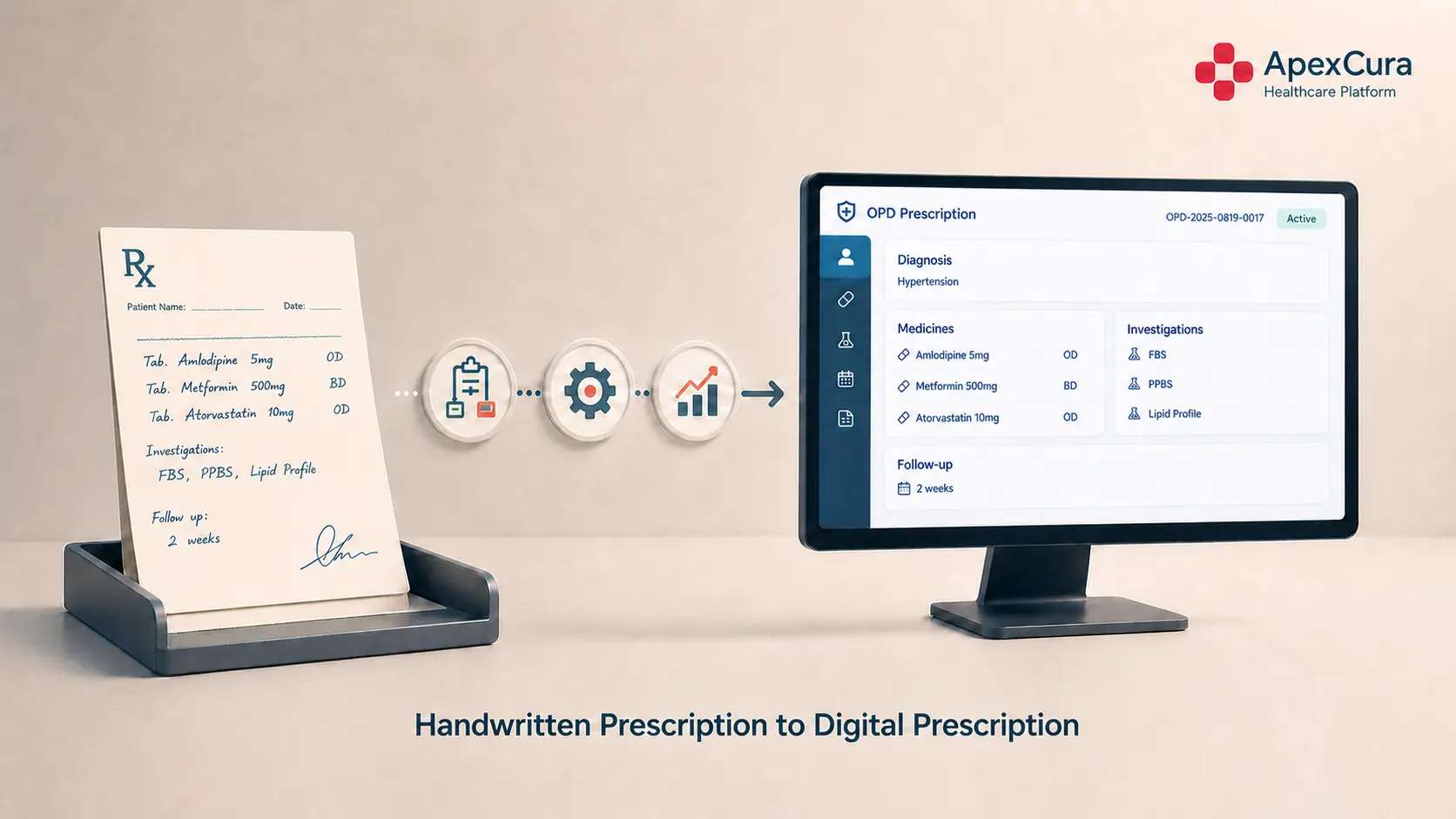
A doctor may speak about medicines, then mention an investigation, return to a finding and finally give follow-up advice. The dictation does not have to match the order of fields in the prescription screen. Voice-to-prescription AI should take the supplied instructions and identify where each detail belongs. This allows the doctor to continue thinking case by case instead of remembering the software sequence. It is also different from ordinary voice typing, which mainly produces one block of text in the order spoken. AI prescription software for hospital OPDs adds structure to the doctor’s instructions so the information can appear in the relevant parts of a digital prescription draft.
See how doctors can speak naturally while AI prepares a structured digital prescription draft for their review.
Explore Voice-to-Prescription AIHow AI Converts the Doctor’s Instructions into a Structured Prescription Draft
AI Organises the Doctor’s Words into Relevant Prescription Fields
After understanding the dictation, AI organises the doctor’s words into the relevant prescription fields. A complaint can move into the complaint section, a stated diagnosis into diagnosis, and medicine instructions into the medicine and dosage fields. Investigations, advice, allergies, history and follow-up can also be placed where relevant, but only when the doctor has supplied that information. Hospital masters may support names and structured selections where configured. The result should be a readable digital prescription draft instead of one long transcript. This organisation saves the doctor from manually copying each spoken detail into separate fields while keeping the original clinical decisions connected with the doctor’s instructions.
AI Prepares the Draft Without Making Clinical Decisions
AI is helping with documentation. It is not taking over the doctor’s clinical work. The doctor examines the patient, decides the diagnosis, selects the medicines, gives dosage instructions and chooses the required investigations or advice. AI should not add any of these on its own. It should also not fill a gap based on what is common for a similar case. If some spoken instruction is unclear, the draft should keep it available for the doctor to correct instead of silently guessing. This boundary is important. A well-written draft may look complete, but every clinical decision must still come from the qualified doctor who conducted the consultation.
The Doctor Reviews, Corrects and Approves the Final Prescription
The output created by AI is first a draft. The doctor should read the complaint, findings, diagnosis, medicines, dosage, investigations, advice and follow-up before approving it. If a word was recognised wrongly or placed in the wrong field, the doctor can correct it. If something was not dictated, the doctor can add it where clinically required. Only after this review should the prescription be finalised, printed or shared with the patient. This is how voice-to-prescription AI for hospital doctors supports digital documentation without removing clinical control. The doctor continues to own the consultation, every treatment decision and the final prescription issued in the hospital.
Conclusion
Voice-to-prescription AI should fit into the way doctors already consult patients. Doctors can ask case-specific questions and speak in their short or cryptic English clinical style. AI identifies only the information they provide and organises it into the relevant prescription fields. It does not diagnose the patient, select medicines or complete missing clinical details. The output remains a draft until the doctor checks and approves it. This gives hospitals a practical path to digital prescriptions without forcing doctors to follow rigid forms. The technology handles documentation structure, while the doctor keeps full control over clinical decisions and the final prescription.